
Madera Projected Release Dates
A projected release date is a forecast based on custody records, sentence information, credits, court orders, holds, and agency processing. The Madera County Inmate Inquiry uses the label Estimated Release Date on the jail detail structure. CDCR and the Board of Parole Hearings use a different vocabulary for state-prison cases, including release and parole-eligible date fields. BOP uses its own federal release date field. These systems do not update at the same speed.
A pretrial detainee often has no fixed release date because release may depend on bail, a citation, a court order, a dismissal, or a new hearing. A sentenced county-jail inmate may have an estimate that changes with credits, discipline, holds, new charges, or court action. A state prisoner may have an Earliest Possible Release Date or a parole-eligible date, but an indeterminate sentence may still require Board action before actual release.
A scheduled date is not proof that a person has left custody. Confirm the actual release through the facility record, court case, VINE, or the agency that holds the record.
Find Madera County Release Dates
The correct lookup starts with the facility. If the person was booked into Madera County Jail, use the county inquiry and include archive records when the person no longer appears in current custody. If the person was at Central California Women's Facility or Valley State Prison, use CDCR CIRIS. If the person has a federal sentence, use BOP. If a court order changed the sentence or release terms, the court record may explain the date before the custody system reflects it.
- Identify whether the person is in the county jail, a CDCR prison, federal custody, or another agency's custody.
- For a Madera County Jail booking, search the Madera County Inmate Inquiry by booking number or name.
- Open the detail view and check Estimated Release Date, disposition, bond, case number, and booking history.
- For CCWF, VSP, or another CDCR case, search CDCR CIRIS and compare identity details.
- Use Madera Superior Court Criminal Division when a court order, sentence, dismissal, or release paper controls the timing.
- Use VINE Inmate Check for a custody-change alert when the person is still in a covered facility.
The CDCR CIRIS source is the statewide search route for a person sentenced to or released from a California prison.
Use CIRIS for state-prison dates, then use BPH or parole records when the date is tied to parole eligibility instead of a simple determinate release.
Madera Release Date Types
California release-date terms can be confusing because a single person may have several dates in different records. The local jail may show an estimate. CDCR may show a release or eligibility date. BPH may show a hearing date or result. The court may show the sentencing order or release paperwork that made the date possible.
| Date or record | System | Meaning |
|---|---|---|
| Estimated Release Date | Madera County Jail | A local custody estimate visible in the jail detail structure when available. |
| EPRD | CDCR/BPH | Earliest Possible Release Date for many determinate state-prison terms. |
| MEPD | CDCR/BPH | Minimum Eligible Parole Date for indeterminate or life-sentence parole consideration. |
| NPED | CDCR/BPH | Nonviolent Parole Eligible Date under Proposition 57 rules when applicable. |
| YPED or EPED | CDCR/BPH | Youth or elderly parole eligible date, subject to statutory criteria and exclusions. |
| BOP release date | Federal custody | Federal release date that may change with sentence review or credits. |
California Credits and Release Dates
Release dates can change because credits and sentence rules are fact-specific. California Penal Code section 4019 is the general local custody credit framework, but the exact credit calculation depends on the sentence, offense, custody status, conduct, and any court orders. A local jail date should be treated as an estimate unless the jail or court confirms the actual release.
California Penal Code section 2933.1 is the source behind the common 85 percent shorthand for some violent-felony sentences. It limits worktime credit to 15 percent for people convicted of violent felonies listed in Penal Code section 667.5(c), and the limit can apply to covered county-jail pre-placement confinement. That rule should not be applied to every person. Different offenses and sentence types can follow different credit rules.
Why Madera Dates Change
A release date can move forward or backward after it first appears. Court orders, amended abstracts, minute orders, resentencing, new charges, warrants, detainers, credits, disciplinary changes, transfers, and parole decisions can all affect the date. CDCR says case records professionals process abstracts of judgment and minute orders as quickly as possible, and Penal Code section 1213(a) requires courts to send documents to CDCR promptly. Even so, public systems can lag while paperwork moves between the court and correctional records staff.
| Change factor | How it affects the date |
|---|---|
| Court order | Can release the person, change sentence credits, dismiss a charge, or amend the term. |
| Hold or detainer | Can keep the person in custody or move the person to another agency after jail release. |
| Credit change | Can alter the estimated date based on conduct, offense category, or sentence law. |
| BPH result | A grant, denial, waiver, or postponement affects parole-based release timing. |
| System lag | May cause jail, CDCR, VINE, and court records to show different timing for a short period. |
Parole Dates for Chowchilla Prisons
For CCWF and Valley State Prison cases, a projected date may not be the final word. BPH hearing schedules can show offender name, CDCR number, hearing type, county of commitment, panel, hearing location, method, scheduled date, and time. Hearing results can show grant, deny, waive, postpone, and other outcomes. A grant should still be checked against review periods and actual release status before treating the person as released.
The BPH hearing calendar source shows how California publishes monthly parole suitability hearing schedules.
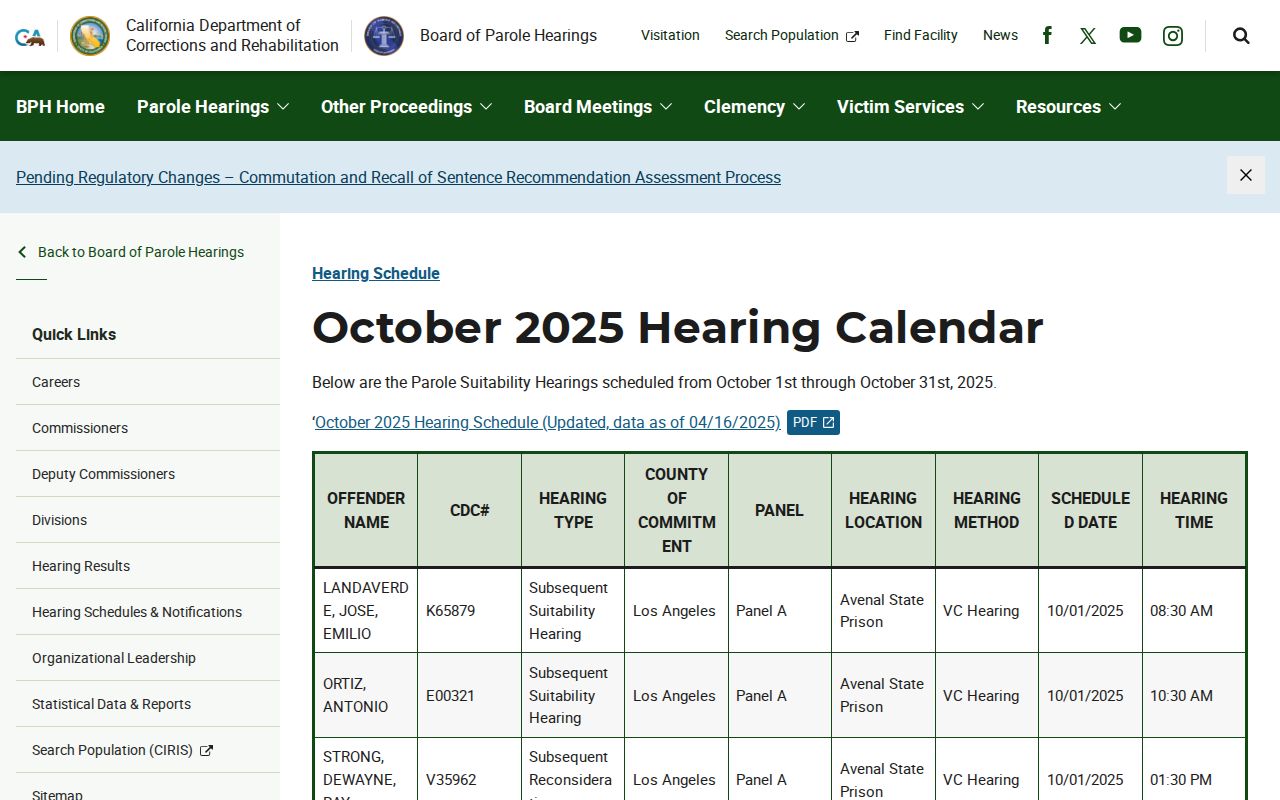
Use the calendar to understand hearing timing, then use hearing results and CDCR status to verify whether release actually followed.
Madera Court Release Orders
Madera Superior Court can explain release timing when the jail detail is unclear. The court portal searches case-management data, but the portal warns that online records are not the official record unless electronically certified. Certified trial-court records require contacting the court. The criminal division handles record searches in person or by mail, and the request form lists the $15 search fee, copy fee, and certified-copy fee.
Release paperwork also ties the jail and court records together. The court tells defendants to appear where directed on the release paper or arraignment letter and to bring jail release paperwork, notice to appear, arraignment letter, or case number. If a projected date changed because of a court order, keep the case number and order date available when contacting the jail, court, CDCR, or facility case records office.
Check Madera Release Timing
When systems disagree, rely on the agency that controls the custody type. County jail dates belong to Madera County Jail and court records. State-prison dates belong to CDCR and BPH. Federal dates belong to BOP. VINE is useful for alerts, but the underlying agency record should confirm the actual release.
Public Record Search
Sponsored Results