
VSP Release Path
Valley State Prison is a CDCR state prison. A person released from VSP leaves the state-prison system or moves into another CDCR-related status, such as parole, PRCS, transfer, or discharge. The public release search begins with CDCR CIRIS. It does not begin with the Madera County Jail inquiry unless there was a separate sheriff booking.
VSP's release path can be more complex than a county jail release because state-prison dates depend on sentence type, credits, parole eligibility, Board of Parole Hearings action, court orders, and case-record processing. Some people have a determinate release date. Others may have a minimum eligible parole date or a hearing result that must pass review before actual release. After release, DAPO or county PRCS may become the confirming supervision path.
| VSP release issue | Use this record | What it can show |
|---|---|---|
| Current or released CDCR status | CDCR CIRIS | State record, location, release status, and relevant dates. |
| Parole suitability | BPH schedules and results | Hearing date, type, county of commitment, and result. |
| Post-release supervision | DAPO or PRCS | Whether state parole or county supervision is likely involved. |
| Separate Madera booking | Madera County Inmate Inquiry | Only a county jail booking, not the state-prison discharge. |
Confirm VSP Release Records
Search CIRIS by CDCR number if available. If only a name is known, compare the result with age and other available identifiers before treating it as a match. The result can point to a release date, custody status, current location, parole eligibility, or a status that needs follow-up through BPH or supervision records. For life-sentence or parole-suitability cases, the BPH record may explain why no simple release date appears.
- Open CDCR CIRIS and search the name or CDCR number.
- Confirm the person and check whether the record identifies VSP, release, discharge, or another CDCR status.
- Review release-related and parole-eligible date fields instead of relying on one date label.
- Check BPH calendars and results if a parole suitability hearing controls release timing.
- Use DAPO or PRCS channels if the person has left VSP but remains under supervision.
The CDCR Valley State Prison facility page identifies VSP's official facility information.
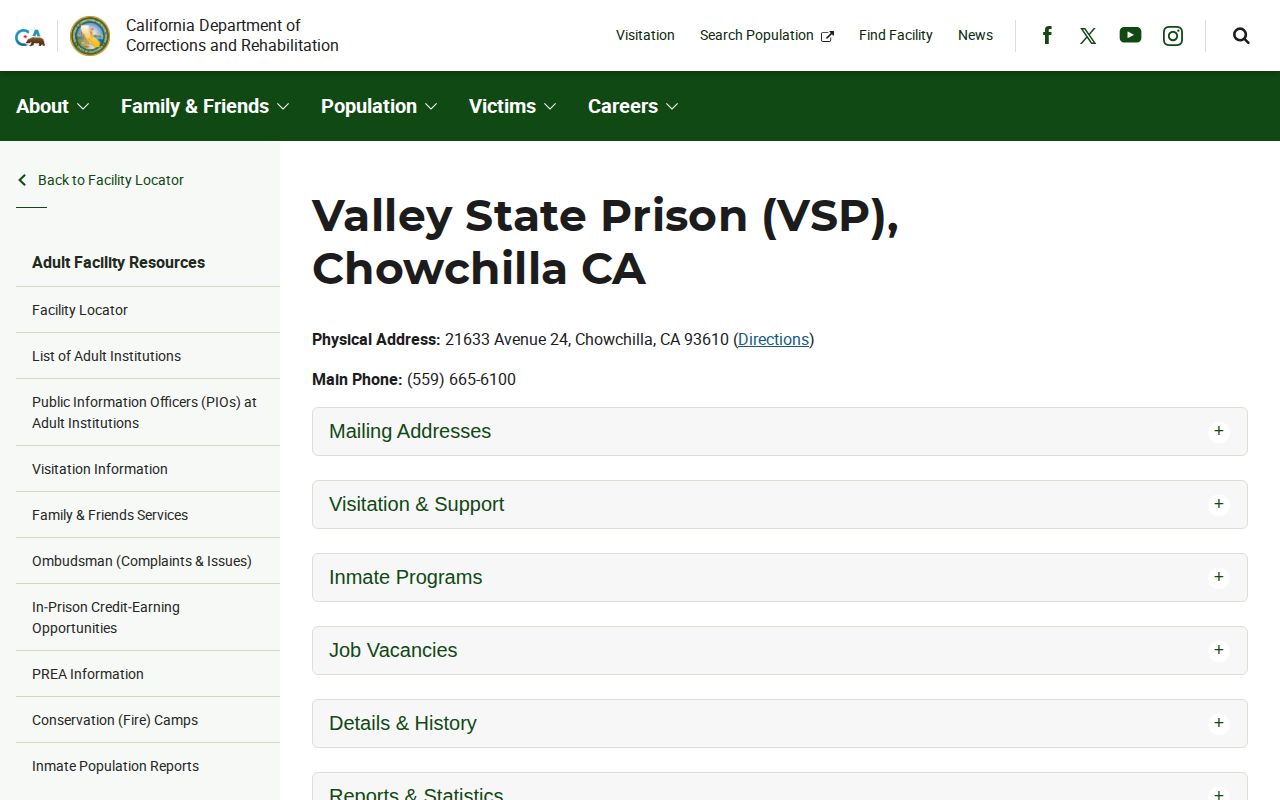
The CDCR facility page helps confirm that VSP is a state-prison facility, which is why CIRIS and CDCR records control release lookup.
VSP Records and Contact
CDCR gives the VSP physical address and main phone number. Contact with the institution should be specific. A caller or requester should be ready with the person's full name, CDCR number if known, date of birth if known, expected release date or parole-eligible date, and the reason a state-prison record is needed. For official court outcomes, the committing court remains important because CDCR release timing can depend on court abstracts and minute orders.
Valley State Prison
21633 Avenue 24
Chowchilla, CA 93610
Agency: California Department of Corrections and Rehabilitation
Main phone: (559) 665-6100
Release search: CDCR CIRIS
After release, supervision can shift. CDCR DAPO handles state parole. CDCR's PRCS materials explain county supervision for people who do not meet DAPO criteria. Madera County Probation is the local county-level route for PRCS or probation questions, but public disclosure may be limited and should be verified with the proper agency.
About VSP Release Records
Valley State Prison is another reason Madera County release research must separate geography from custody authority. VSP is physically in Chowchilla, but a release from VSP is not a Madera County Jail release. The research notes that VSP was originally Valley State Prison for Women and that realignment affected the female offender population and facility mission before the current state-prison context. For release lookup, the historical note is less important than the record owner: CDCR holds the state-prison record.
BPH schedules and results can matter for VSP because a person housed at the facility may have a parole suitability hearing there even if the county of commitment is somewhere else. The hearing calendar can list offender name, CDCR number, hearing type, county of commitment, panel, hearing location, method, date, and time. Results can show grant, deny, waive, postpone, or another proceeding outcome. A hearing grant should still be checked against review periods and the actual CDCR release status.
County of commitment, current CDCR facility, and Madera County Jail booking records are different fields and should not be merged.
Madera County State Prison Releases
Section 19 identifies the two Chowchilla state prisons as a defining Madera County angle. VSP and Central California Women's Facility are both CDCR facilities. A searcher may say "Madera County released inmate" because the person was housed in Madera County, but the release record can still belong to the state. That is why a no-result search in the county jail archive does not disprove a VSP release.
Use Central California Women's Facility release records for CCWF and VSP records for Valley State Prison. Use the county jail page only for a local booking. When a person moves from state prison to supervision, use DAPO or PRCS. When a court changes the sentence, use the court order and CDCR case-records processing path.
VSP Release Date Terms
State-prison release dates use terms that do not match a county jail's estimated release date. EPRD is tied to determinate sentences and credits. MEPD relates to indeterminate or life sentences. NPED, YPED, and EPED relate to nonviolent, youth, and elderly parole eligibility where rules apply. These are eligibility or release-planning concepts, not always a promise that the person will walk out on a fixed day.
Credits, disciplinary changes, resentencing, court documents, detainers, parole review, and BPH outcomes can change the practical date. If the person is still housed at VSP, CDCR records and case records are the right sources. If the person was released and is under parole or PRCS, the supervising agency may be the better route for current status.
Search VSP Release Records
Use the search below as a broad public-record option. Official VSP release confirmation should be matched to CDCR CIRIS, BPH records where relevant, CDCR case records, and the correct parole or PRCS supervision channel.